
Sale!

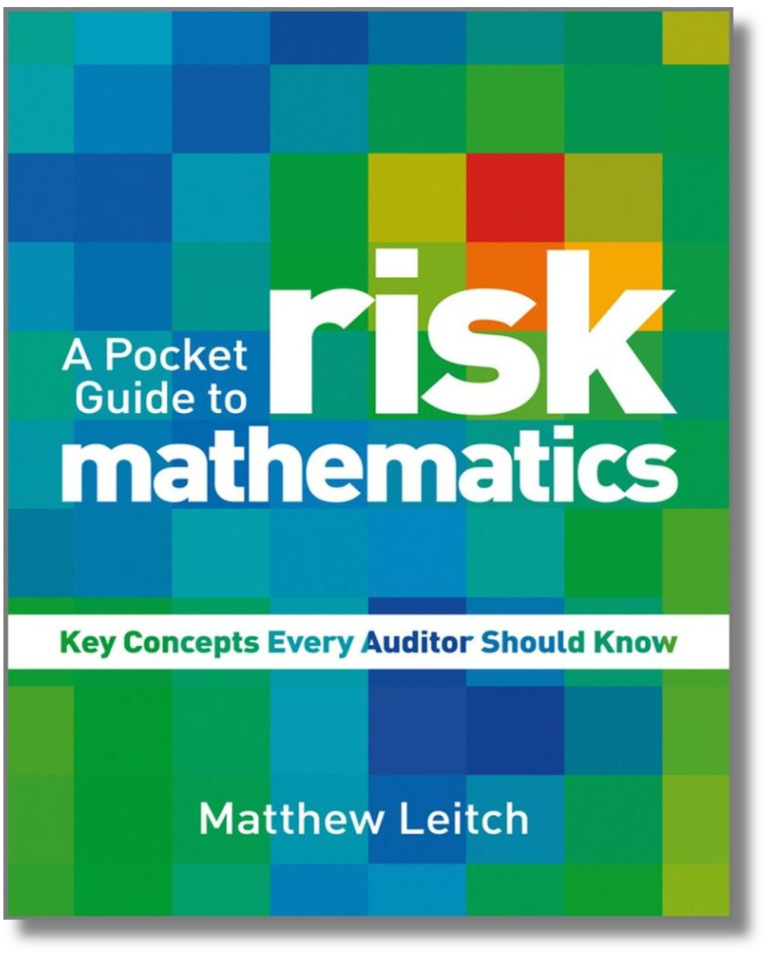
A Pocket Guide To Risk Mathematics: Key Concepts Every Auditor Should Know
Original price was: $49.99.$19.97Current price is: $19.97.
Description
This uniquely accessible, breakthrough book lets auditors grasp the thinking behind the mathematical approach to risk without doing the mathematics.Risk control expert and former Big 4 auditor, Matthew Leitch, takes the reader gently but quickly through the key concepts, explaining mistakes organizations often make and how auditors can find them.Spend a few minutes every day reading this conveniently pocket sized book and you will soon transform your understanding of this highly topical area and be in demand for interesting reviews with risk at their heart.”I was really excited by this book – and I am not a mathematician. With my basic understanding of business statistics and business risk management I was able to follow the arguments easily and pick up the jargon of a discipline akin to my own but not my own.”—Dr Sarah Blackburn, President at the Institute of Internal Auditors – UK and Ireland
9 reviews for A Pocket Guide To Risk Mathematics: Key Concepts Every Auditor Should Know
Related products
-
Sale!
Calculus: An Intuitive and Physical Approach (Second Edition) (Dover Books on Mathematics
Original price was: $39.99.$19.98Current price is: $19.98. Add to cart -
Sale!
College algebra and trigonometry, global edition
Original price was: $149.99.$19.98Current price is: $19.98. Add to cart -
Sale!
Secrets of mental math : The mathemagician’s guide to lightning calculation and amazing math tricks
Original price was: $29.99.$19.96Current price is: $19.96. Add to cart
Colin McLarty (verified owner) –
A recently developed approach to calculus lets Bell go very quickly from the basic definitions up to several interesting applications in geometry and mechanics. This version of calculus bypasses a lot of technical details to focus on the geometric meaning. If you have had analytic geometry then in principle you could read this book. It would be better if you have had some exposure to calculus but you do not need to remember much of it, and this book can quickly take you farther.
Readers who want to get to the applications can skim through much of the first chapter, on historical and philosophic motivations for the approach.
But a word for specialists: the book is also valuable as an exploration of this approach, called “synthetic differential geometry”. This was created to make calculus more accessible but most people writing about it have focussed on theoretical investigations, as it involves a number of very new ideas. By writing on the introductory level, with rather advanced geometric applications, Bell has brought out novel aspects of the approach. Logicians and mathematicians interested in this foundation for geometry, or in elementary topos theory, should see what he has done.
Sam (verified owner) –
What lurks behind the approach taken in this
important and finely-rendered book is not widely
appreciated. Why so slow everyone? Are we in
a Dark Age? Nature abhors the perfect discontinuity.
Natura non facit saltus! Smoothness rules, okay?
Prof Dr Thomas Sonar (verified owner) –
into one of the possible interpretations of nonstandard analysis. Here, the starting point is the “smooth world”, a space where all functions are smooth. If this reminds you on Leibniz you will not be astonished to see in proof that in such worlds infinitesimal quantities are possible! In particular, nilpotent infinitesimals are introduced and calculus is shown to work very well with them. In a way this book recovers the notions of “linelets” and “timelets” of Barrow. However, if you really want to understand what is going on in the foundational underground, you have to go deep into model theory. The book ends by just giving a glimpse into this field.
aethr (verified owner) –
Or maybe just a very good introduction to a variation on infinitesimal analysis. As someone who disliked limits the first time I came across them, and having watched students I was teaching stumble (way too early in the semester) when limits are introduced, I wish more mathematicians would become aware of this approach. Combining this book with “Calculus Made Easy”, where nilpotent infinitesimals are used intuitively, might make for an excellent, limit-free introduction to calculus.
David Karapetyan (verified owner) –
A bit philosophically heavy at times and initially the loss of the law of the excluded middle is a little disconcerting but one gets used to the new logic quickly enough.
Stephen Cresswell (verified owner) –
I would recommend this book to anyone who needs to make or review quantitative analyses. This is not a thick difficult to read academic tome, but a concise summary of a number of key topics. These are well set out in the Table of Contents making the book an ideal reference. Potentially useful to anyone who carries out analyses and wants to make sure they’ve covered all angles.
Freethinker (verified owner) –
Extremely interesting read! Definitely not for beginners. This is smooth infinitesimal analysis involving nilpotent non-invertible infinitesimals. These are non-zero infinitesimals whose “squares” are zero that are used in synthetic differential geometry. These are very unlike the infinitesimals used in Keisler’s and Henle’s books. Historically they are more like Nieuwentijdt’s infinitesimals than Leibnitz infinitesimals. Highly recommended for those with some mathematical logic and set theory background,
Marco Bottacini (verified owner) –
good
Yong Xu (verified owner) –
This book is in very good condition.